Business Growth
Converting Traffic into Revenue: A Practical Framework for Busy Founders
Connective Teams · 7 Okt 2026
Converting Traffic into Revenue: A Practical Framework for Busy Founders
Visitors arrive on your site daily, but sales remain flat. Discover a practical framework to fix leaks in your conversion funnel today.
Your analytics dashboard shows steady visitor numbers. Your ad spend is working, yet your bank account tells a different story.
Traffic without revenue is just digital noise.
Most time-poor founders assume they need more visitors to grow. They double down on top-of-funnel campaigns, pouring budget into channels that bring empty clicks. Meanwhile, the actual problem hides in plain sight on their existing web pages.
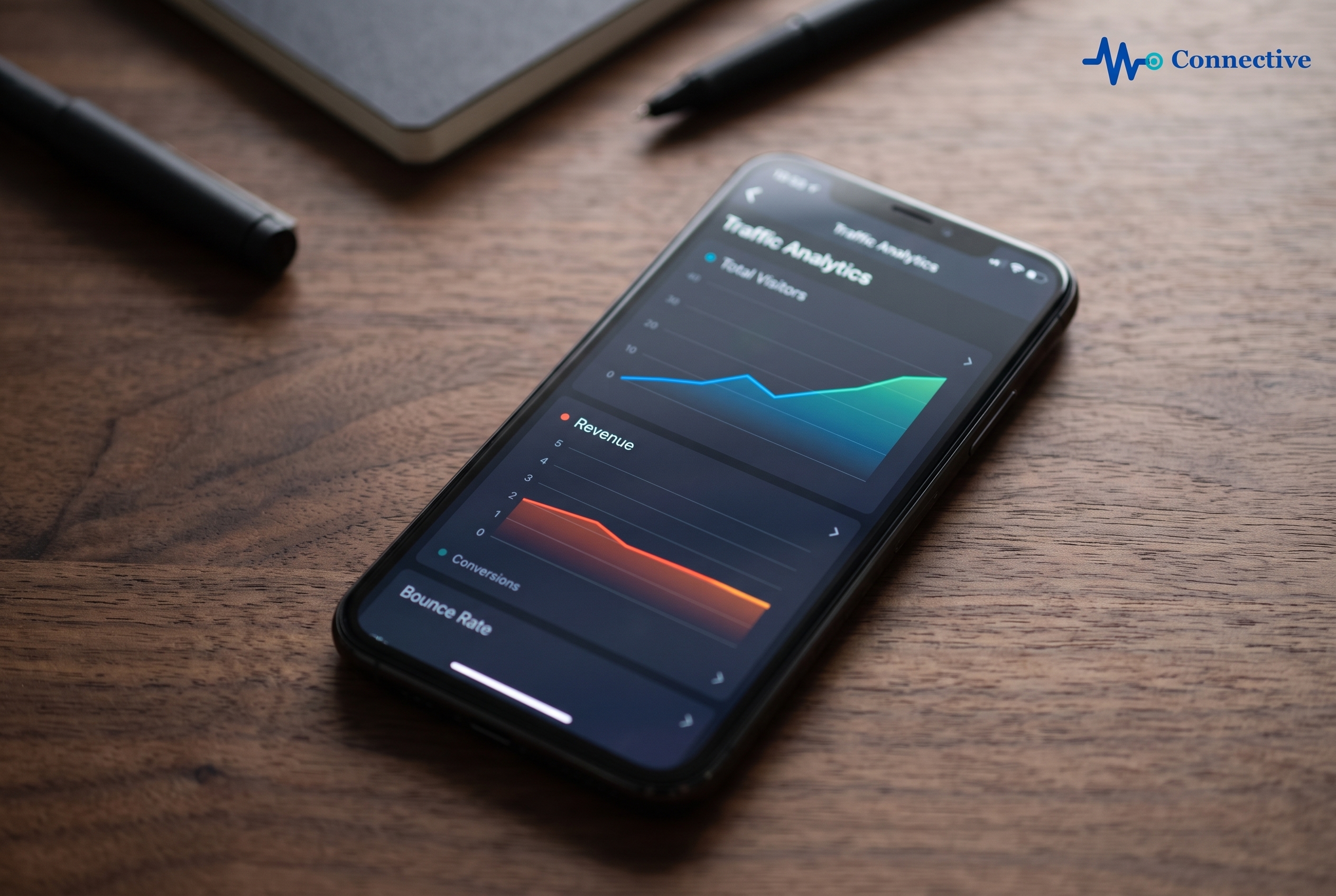
Why Traffic Fails to Become Revenue
Visitors rarely buy on their first arrival. They land on a homepage, scan for three seconds, and leave because the core offering is unclear.
Consider a typical B2B software startup. Founders spend months refining code and weeks crafting ad copy. Yet, their website headline reads like a textbook rather than a direct solution to a buyer's immediate problem. When a prospective client arrives, they cannot figure out what the product does within five seconds.
Friction kills conversion. Every extra form field, every broken mobile layout, and every vague call-to-action pushes potential clients toward competitors.
Fixing this does not require a massive marketing department or endless testing cycles. It requires a systematic audit of where attention breaks down between the landing page and the checkout or booking form.
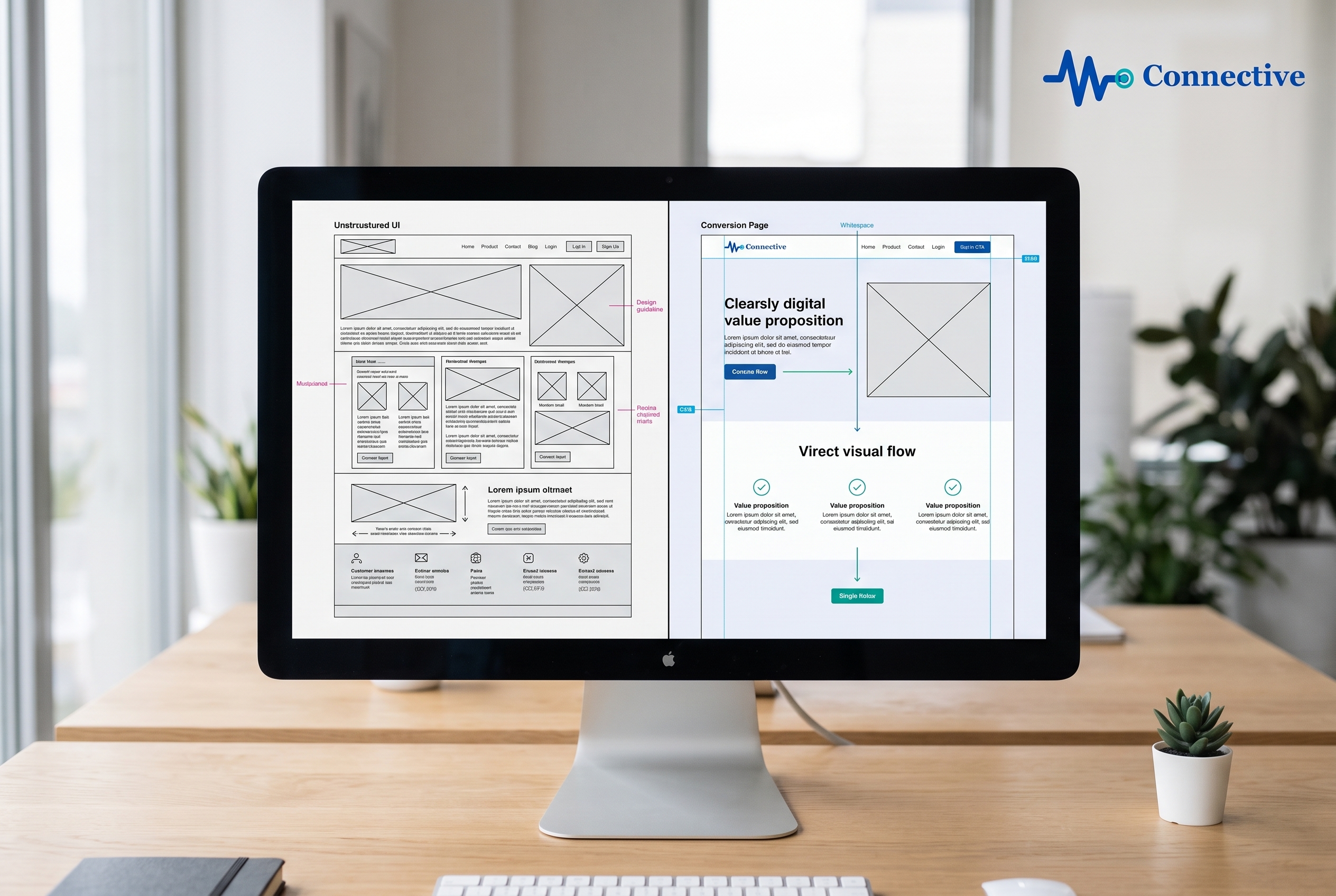
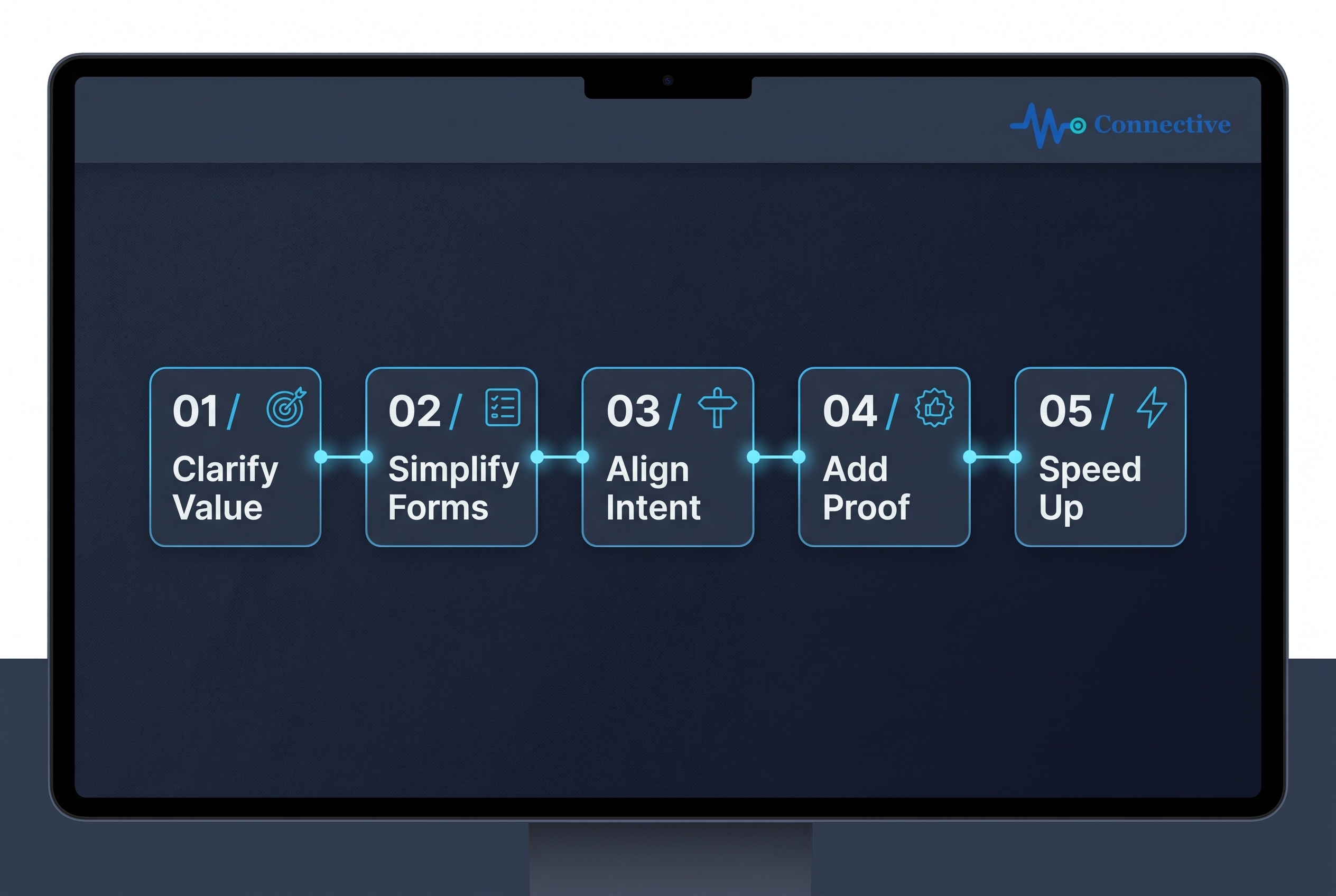
The 5-Step Actionable Framework for Busy Executives
Founders need efficient interventions that yield measurable outcomes quickly. This five-step process targets the most common conversion leaks without requiring a complete operational overhaul.
- Clarify the Above-the-Fold Value Proposition. Strip away industry jargon. State explicitly what you do, who you help, and the exact result you deliver within the first viewport of your homepage.
- Remove Unnecessary Form Fields. If your contact or demo booking form asks for company size, annual revenue, and postal code on step one, abandonment rates spike. Ask only for an email address and name initially.
- Align Traffic Intent with Landing Pages. If a user clicks an ad promising enterprise cybersecurity solutions, they must land on a dedicated page about cybersecurity—not your generic homepage.
- Introduce Social Proof Near Conversion Points. Place a specific client testimonial or a recognizable industry logo directly beside your primary call-to-action button to reduce buyer hesitation.
- Optimize Mobile Load Speeds. Roughly half of all B2B research happens on mobile devices. If your site takes longer than three seconds to render, users leave before seeing your offer.
A Worked Example: Fixing a Leaking B2B Funnel
Take an industrial logistics firm spending four thousand dollars monthly on search advertising. They receive approximately four thousand monthly visitors. Their current conversion rate sits at 0.5 percent, yielding twenty leads per month.
At an average contract value of five thousand dollars, gross pipeline value equals one hundred thousand dollars.
By conducting a targeted website redesign focusing on simplified navigation and clear conversion paths, the firm increases its conversion rate to 1.5 percent. Visitor volume remains identical.
Leads jump to sixty per month. Pipeline value triples to three hundred thousand dollars without increasing ad spend by a single dollar.
The leverage point was never the traffic acquisition channel. The leverage point was the digital architecture catching that traffic.

Common Mistakes That Sabotage Conversion Rates
Even experienced leadership teams often fall into predictable traps when attempting to fix low sales figures.
- Chasing aesthetics over clarity. A stunning, award-winning animation sequence impresses design peers, but it confuses procurement managers who just want to read pricing tiers and case studies.
- Hiding pricing and process. B2B buyers hate filling out forms just to learn baseline costs. Providing transparent pricing tiers or clear project cost calculators filters out unqualified prospects while building immediate trust with serious buyers.
- Using generic calls to action. Buttons labeled "Submit" or "Click Here" offer zero psychological incentive. Replace them with action-oriented phrases like "Calculate Your ROI" or "Schedule a Strategy Review."
Partnering for Sustainable Digital Growth
Scaling revenue through digital channels demands consistent attention—a luxury most founders simply do not possess.
Juggling product development, team management, and client delivery leaves little room for split-testing landing pages or auditing site architecture. This is where an integrated digital partner provides operational relief.
Instead of managing separate freelancers for web development, SEO, and copywriting, working with a dedicated remote team ensures every element of your digital footprint aligns with your revenue goals.
Marketing Connective acts as your dedicated digital marketing assistant, bridging the gap between web design and strategic growth. Whether you need a high-impact website redesign or continuous conversion rate optimization, having an always-on partner allows you to focus on running your business while your digital presence works around the clock to generate revenue.
Frequently asked questions
Short answers to the questions readers ask most often.
Why is my website getting traffic but no sales?
Visitors often leave immediately if your core offering is unclear within the first few seconds, or if friction in forms and mobile loading speeds interrupts their journey.
How can I improve B2B website conversion rates quickly?
You can clarify your above-the-fold value proposition, remove unnecessary form fields, align traffic intent with specific landing pages, add social proof, and optimize mobile load speeds.
Do I need more ad budget to increase my online revenue?
Not necessarily. Improving your digital architecture and conversion pathways can often triple your pipeline value using your existing visitor volume.
Turn Existing Traffic Into Revenue
Stop losing prospective clients to confusing layouts and long forms. Partner with Marketing Connective to optimize your digital architecture and generate consistent B2B growth.
View Pricing Packages · Explore Our Services · Schedule a Strategy Review